

Your neighbor's basement is flooding, and he has told you how he plans to fix it: block the failed drain, regrade the alley the two of you share, and, if you will not go along with it, raise his own side so the water runs toward your house. Your neighbor cannot fix his flooding problem by sending the water toward your house. This guide explains why, and what to do about it, drawing on a real dispute we were asked about in The New York Times Ask Real Estate column on August 1, 2026.
Before he can proceed, there may be four separate obstacles: who owns the alley, whether an easement controls it, the permits the work would require, and the fact that he cannot touch your property without your consent or a court order. You can also call 311 to report suspected illegal work at any time.
The bottom line. A neighbor cannot solve a drainage problem by transferring the water and the damage to the property next door.
The question that reached the Times
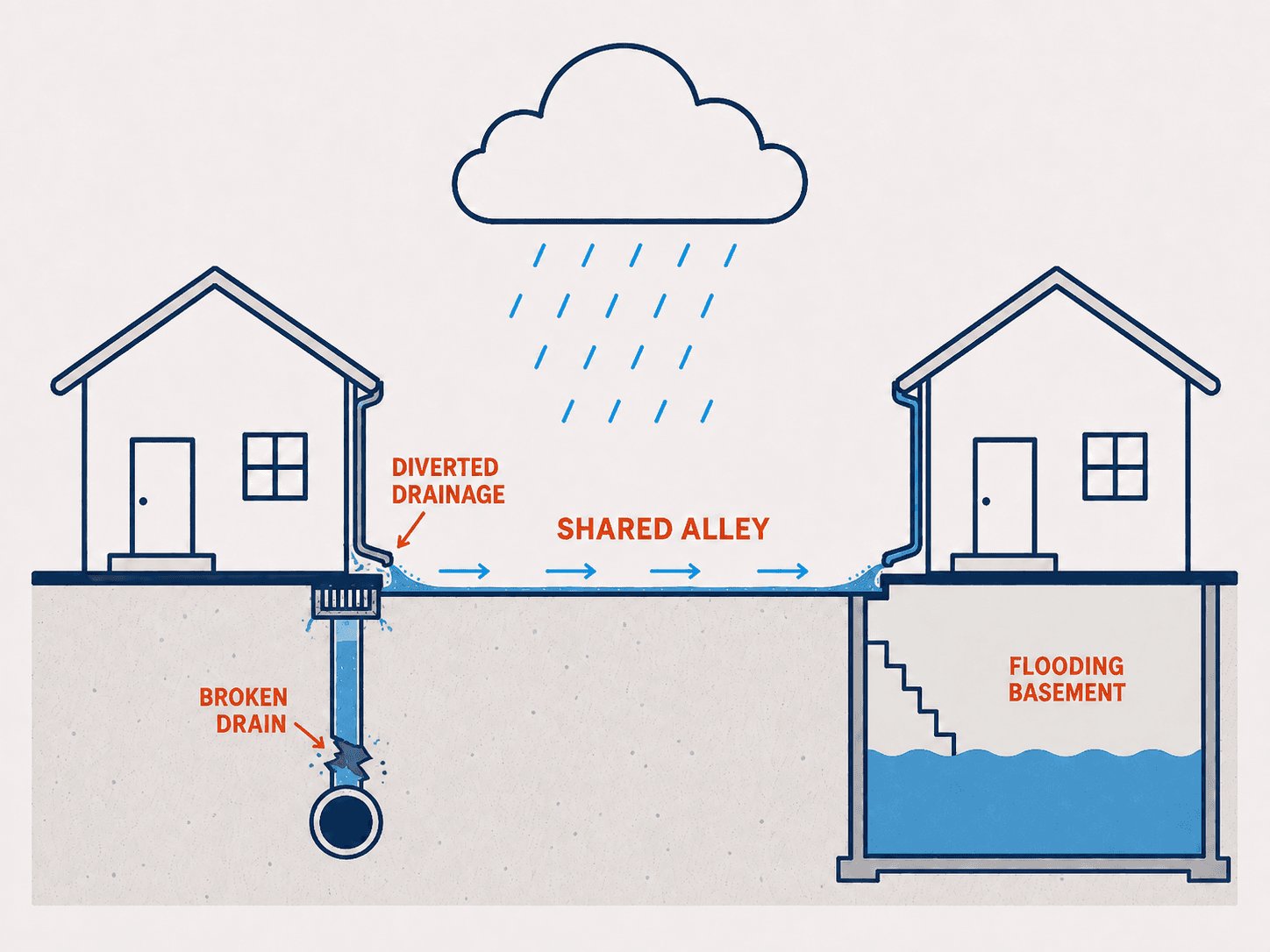
The column took a reader question narrower than this guide, but it shows exactly how these disputes start. A homeowner owns a single-family detached house in one of the boroughs. A paved alley runs between that house and a multi-unit building next door, and the two properties share it.
The neighbor's basement floods because the drain that carries water to the sewer on his side has failed. He says clearing or repairing that drain is too expensive. Instead, he proposes to block it, regrade the alley, and route all of the water, downspouts included, toward the street.
That plan comes with a threat: if the homeowner will not cooperate, he will raise his side to push the water at the house. The threat is the point, because a stated plan to send water toward the neighbor is what turns a private drainage problem into a legal one.
First, document everything
In practice, the most important evidence is usually created before the work begins. Once the grade changes and the water starts moving, it is harder to prove what the alley looked like and who caused the problem.
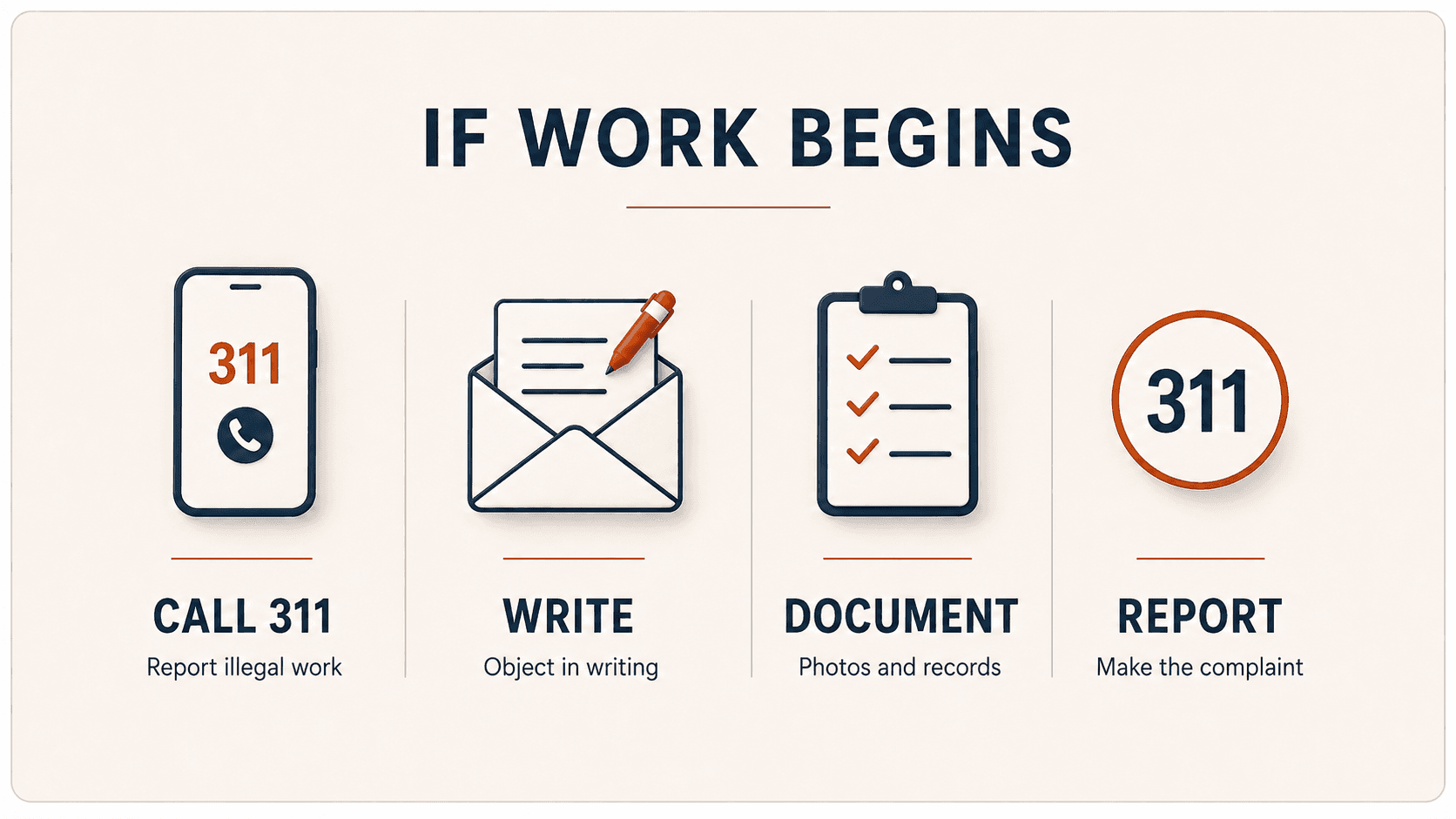
You can call 311 and report the matter to the City and the Department of Buildings at any time. The City will send an inspector out for any suspected or alleged illegal work, unsafe condition, or occupancy issue, and that channel is open before a shovel goes in the ground.
Who owns the alley, and who may do the work
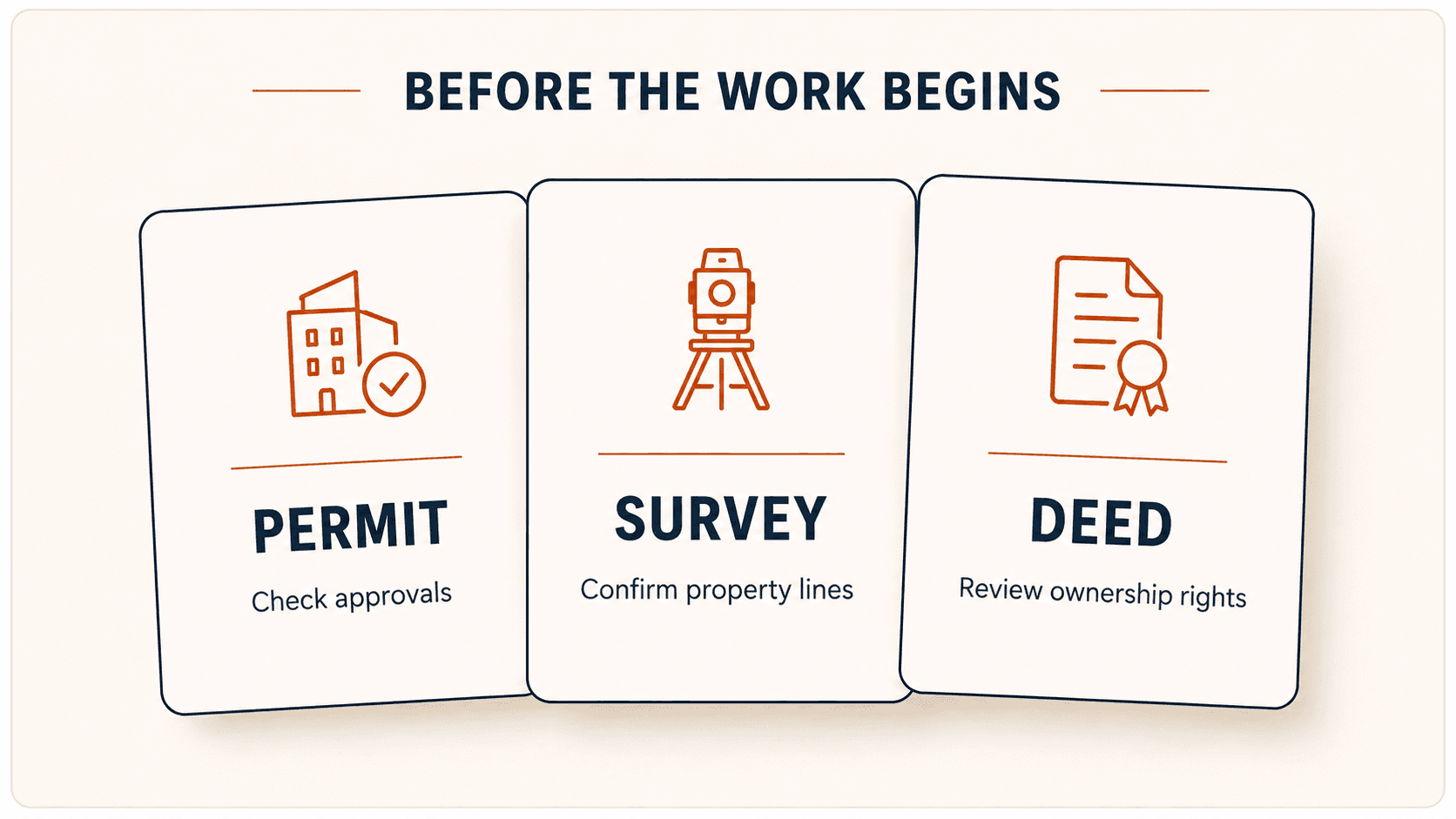
A neighbor cannot enter or alter your property without your permission or legal authority. That rule is firm. Whether he may change the shared alley itself is a separate question, and it depends on who owns the alley and whether the deed, survey, and easements give either owner the right to do the work.
If you do not consent to work that needs access to your property, the neighbor's route is to ask a court for permission under RPAPL § 881.
What RPAPL 881 does, and does not, allow
New York RPAPL § 881 lets an owner or developer ask a court for a temporary license to enter a neighbor's property when repairs or improvements cannot otherwise be completed in a commercially reasonable manner.
It does not, on its own, let the neighbor:
- Alter your property
- Override an easement
- Perform unpermitted work
- Redirect water onto your property
An access license is a narrow tool for temporary entry. It is not permission to reengineer a shared space.
When unilateral action becomes a violation
This is where a neighbor who acts alone can run into trouble. NYC Admin. Code § 28-301.1 requires every owner to keep the building and its equipment in safe, code-compliant condition. The maintenance code may require the owner to repair the failed drainage condition rather than transfer it next door, and a drain that pushes water onto a neighbor arguably falls short of that duty. I have seen failure-to-maintain violations issued for considerably less serious conditions, including:
- Air-conditioning units blocking a fire escape
- Dilapidated fencing
- Cracks in pavement or steps
The Plumbing Code is more specific. Section 1101.2 generally requires paved areas, yards, courts, and courtyards to drain into a storm sewer, a combined sewer, or another approved place of disposal. Section 1101.12 prohibits grading or other land-contour work that causes stormwater to flow onto adjacent property.
A shared alley is not necessarily an approved point of disposal, and neither is the neighbor's own lot unless there is an approved drainage point or system. A neighbor who does the work without the required permits may receive a violation and a stop-work order on his own property.
Improving your own land versus diverting water next door
New York lets an owner improve his land even when the work incidentally changes how water runs off it. What the law does not allow is the artificial collection or diversion of water onto a neighbor, or a change made in bad faith to move a known drainage problem next door.
Here, regrading the alley to avoid repairing the drain could be improper, and the neighbor's announced intention to push the water toward the house is exactly the kind of fact a court weighs.
Practical steps if a neighbor threatens your drainage
I would not wait until the alley has already been regraded to make the first complaint. If a neighbor has raised a plan like this, take these steps in order:
- 1Photograph the alley as it exists now, timestamped and dated. A clear record of the current grade and the failed drain is the baseline everything else is measured against.
- 2Pull the deed and check for easement language covering the alley. An owner should not assume that shared use of an alley gives either side the unilateral right to change its grade. The deed, survey, and easements must be reviewed first.
- 3Send a certified letter objecting in writing. A dated, certified objection forecloses a later argument that you acquiesced.
- 4If work begins, call 311 that day. Same-day reporting puts the City on notice while any unpermitted grading is still in progress.
On a separate note: a flooded basement apartment is more than a property dispute. Illegal basement units that take on water can be deadly for the people living in them, and they should be reported to 311.
Frequently asked questions
Does it matter that he announced the plan in advance?
It can. New York lets an owner improve his own land even when runoff is incidentally affected, but it does not allow water to be collected and diverted onto a neighbor, or a change made in bad faith to move a known problem next door. A stated plan to redirect the water toward your property speaks to that intent.
What if the work is entirely on his own property?
Grading or other land-contour work that causes stormwater to flow onto adjacent property is prohibited even when the work sits on his side of the line. His drainage still has to reach an approved point of disposal, and a shared alley or his own lot does not count unless there is an approved drainage point or system.
Do I have to let him onto my property if a court grants access?
A court can grant a temporary license under RPAPL § 881 for entry that is needed to complete repairs or improvements. That license is limited and temporary. It does not let the neighbor alter your property, override an easement, do unpermitted work, or redirect water onto your land.
Who pays if my basement floods after he regrades?
A Buildings violation penalizes the neighbor but does not compensate you for damage. A claim for damages or an order stopping the work is a separate, civil matter, and it can proceed in parallel with any City enforcement.
A different neighbor problem?
A shared alley is one version of a single problem: a neighbor doing something to his property that reaches yours. We advise owners on the range of these disputes, including:
- Boundary lines and encroachments
- Fences and retaining walls
- Construction or excavation next door
- Tree and root damage
- RPAPL 881 access demands
- Water reaching your property from other sources
If your situation looks different from the one above, our litigation and disputes practice is the place to start.
Talk to us
The early moves in a dispute like this carry the most weight, and most of them happen before anyone files anything. If you would like a second set of eyes before you act, reach our office through the contact form on this site or at 592 Pacific Street, Brooklyn. An initial case review is free.
This article is attorney advertising and is provided for general information only. It is not legal advice for your specific situation, and reading it does not create an attorney-client relationship. Statutes and code sections change, so confirm the current text and how it applies to your property before you rely on it. Prior results do not guarantee a similar outcome.

