
A renter’s plain-language field guide
What Does NYC’s Rental Ripoff Report Mean for Tenants?
I read all 68 pages of the City’s July 2026 Rental Ripoff Report so you do not have to. Here is the short version: it gives renters real rights, and it puts dates on when each one arrives. Some rights are live today. Others are still proposals. This guide sorts them, in plain language, so you know what you can use now.
By Michael Nacmias, Esq.
Read the full 68-page report at nyc.govWhat does NYC's Rental Ripoff Report mean for tenants?
Quick Answer
1 in 6
tenant helpline calls are about harassment
1 in 3
repairs marked fixed were not actually fixed
$15,475
in broker fees already returned to renters
160,000
serious violations sitting open citywide
- The report gives tenants real rights, and it puts a date on each one.
- The broker-fee law is live now: you do not owe a fee to a broker you never hired.
- This heat season, every complaint you file by name gets its own inspection. Always include your apartment number.
- You can challenge a false repair sign-off. About one in three self-certified repairs were not really done.
- Use your rights with care. Never stop paying rent without legal advice first.
Companion guide
Own a building? Read the owner’s guide to this report.
Why this matters to you
The Mayor’s Office to Protect Tenants published this report in July 2026, after 2,419 New Yorkers testified across all five boroughs.
It is not a recap of that testimony. It sets out 23 recommendations for protecting renters, and it reads as a schedule with dates, not a wish list.
Some of these rules are live today. Others are still proposals. The difference matters: you can use a live rule this week, while a proposal is only something to watch. I mark every item as live now or proposed so you know which is which.
You can read the primary source yourself: the full 68-page report at nyc.gov, and the City’s press release announcing it.
A note on who we are
I represent both tenants and building owners across the five boroughs. Because I also work the owner side, I know how landlords and their lawyers react when a tenant pushes back. That helps you. If we already represent your landlord, I will tell you right away. Read this as a map of what you can actually do, from someone who sees how both sides handle it. These rights are real. Use them carefully and get advice when the stakes are high.
Bottom line: Read this document as a calendar of new tenant rights. Sort each item into “live now” and “still proposed,” and use the first group with care.
What 2,400+ New Yorkers testified about
The hearings catalogued which conditions drove renters to speak up. Pests and leaks lead the list, and several of these problems are named in the dated changes later in the report.
Source: Rental Ripoff Hearing Report, p. 24. Bars scaled to the largest category.
Why tenants call the helpline
The City’s Tenant Helpline tracks why renters reach out. Harassment is the single biggest reason, about one in six calls. Repairs and eviction pressure come next.
Source: Rental Ripoff Hearing Report, p. 16. Bars scaled to the largest category.
What you can do right now
Before you wait on any proposal, use the rights that are already in force. These are law today, not plans.
No forced broker fees
Under the new broker-fee law (the FARE Act), you do not owe a fee to a broker you never hired, and all fees must be disclosed up front. The City has already charged over 79 summonses and $36,125 in penalties, with $15,475 returned to renters.
Elevator out more than 14 days
Since June 2026, if an elevator is out for more than 14 days, the owner must offer alternative arrangements and post notices on the affected floors. If that is not happening, that is a live rule you can point to.
Challenge a false repair claim
You have the right to challenge a landlord’s claim that a repair was done. About one in three self-certified repairs were falsely certified in fiscal year 2024-25, so if it is not fixed, say so.
A repair case in Housing Court
You can bring a repair case in Housing Court, where a judge can order the repairs and fine a landlord who ignores the order. Rent-regulated tenants can also ask the state for a rent reduction when services decline.
Bottom line: Four rights are already in force: no forced broker fees, the 14-day elevator rule, the right to challenge a false repair sign-off, and a repair case in Housing Court.
When your new rights arrive
- Live nowJune 2026
Broker-fee law, elevator rule, and challenging false repairs
The broker-fee law (the FARE Act) is in force, the 14-day elevator rule is posted, and you can already challenge a landlord’s claim that a repair was made. These are the rights to use this week, because they are law right now.
- Heat seasonOctober 2026
Every heat complaint gets its own inspection
From the October 2026 heat season, every non-anonymous heat or hot-water complaint you file gets its own inspection attempt. The old practice of batching complaints as duplicates ends. There were more than 300,000 heat complaints in 2025, so include your apartment number every time.
- Bronx firstFall 2026
311 texts, building-wide inspections, and a harassment guide
311 will text you to schedule the inspection window, so you do not miss the inspector. City interagency teams begin top-to-bottom inspections of whole buildings flagged by organized tenants, starting in the Bronx. And the City will publish one official online guide for documenting and reporting harassment.
- ProposedNot final yet
Rent-withholding, tenant associations, and screening reform
Still proposals, not law: expanding the list of serious violations that let a tenant legally withhold rent, official recognition of tenant associations, a rule that a landlord could require a credit check or proof of income but not both, disclosure of AI-altered listing photos, and leases that must say which utilities you pay.
Bottom line: Only the live-now rights and the October heat-complaint change are already fixed on the calendar. Everything marked proposed can still change, so watch it, do not rely on it.
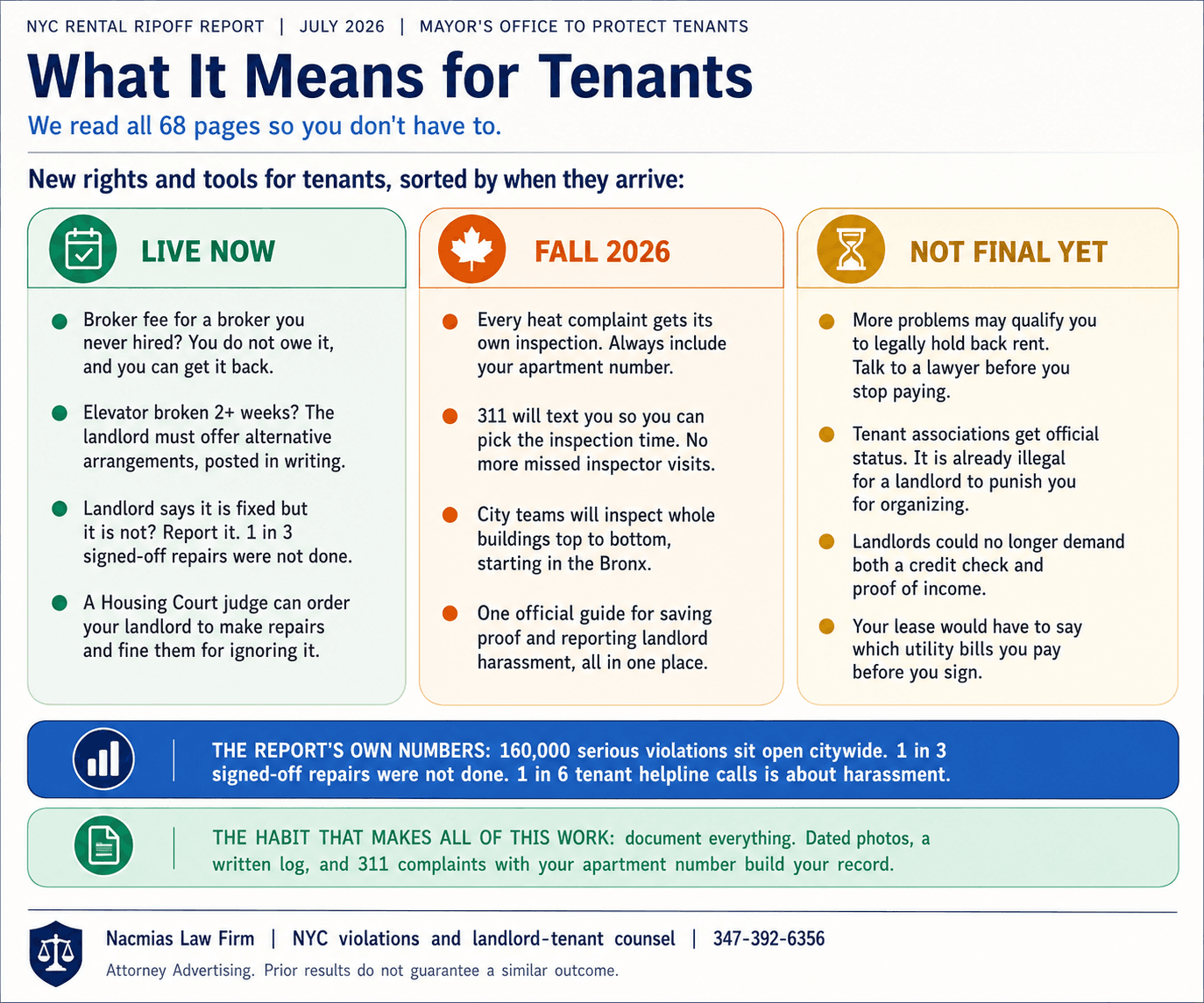
The one-page tenant summary
Here is the whole picture on a single page. Save it, screenshot it, or send it to a neighbor so the dates and the new rights sit in one place. Then go to the source: the full 68-page report at nyc.gov.
When the landlord says it is fixed
Do not assume a repair is done just because the record says so. A landlord can tell the City a condition is corrected when it is not. You have the right to challenge that claim, and the numbers say you should look before you trust it.
The certification gap
1 in 3
repairs marked fixed were not actually done, based on the City’s own audit of self-certified repairs.
City rechecks of the most serious violations in 2025
The City is rechecking these repairs far above the required rate.
Source: Rental Ripoff Hearing Report, pp. 45-46.
So if a repair is marked corrected and it was not, challenge it. Report that the condition is still there, keep dated photos, and note the date the landlord claimed it was fixed. That record is what turns your word against theirs into something a City inspector or a judge can act on.
If reporting does not move it, you can bring a repair case in Housing Court. There a judge can order the repairs and fine a landlord who ignores the order. For background on how those cases and inspections work, see the landlord-tenant practice overview.
Bottom line: A repair marked done is not proof it was done. About one in three were not. Challenge the ones that are still broken, and keep the dated photos that prove it.
How common bad conditions are
If your apartment has one of these problems, you are far from alone. The City’s 2023 housing survey found bad conditions in a large share of rentals.
27%
of rentals had rodents
20%
had leaks
18%
had insufficient heating
10%
had mold
Source: Rental Ripoff Hearing Report, p. 17, citing the 2023 NYC housing survey.
Bottom line: These conditions are widespread, which is part of why the City built new reporting and inspection tools around them. A common problem is still a problem worth reporting.
Holding back rent, carefully
Never stop paying rent without legal advice first. The right to withhold rent for serious conditions is real, but it is narrow, and doing it wrong can invite an eviction case against you. This is the part of the report to be most careful with.
Here is the honest picture. For certain serious violations that can affect your rent, the law already supports a rent-withholding defense while the condition stays uncorrected. That is a defense, not a free pass, and it depends on the specific violation and whether it is properly on record.
The list is old and may grow
Proposed in partThe list of serious violations that support withholding has 75 items and has not changed since 1992. Roughly 160,000 of these violations are open citywide. The report proposes expanding the list, but that expansion is not final.
The risk is real
If you stop paying rent and a court later decides the withholding was not justified, you can face an eviction case for nonpayment. That is why advice comes before action.
Tenant associations may get recognition
Proposed in partThe report also proposes official recognition of tenant associations, plus possible city-enforced agreements with owners. That is proposed, not law.
Bottom line: The rent-withholding defense exists, but it is narrow and easy to get wrong. Get advice before you hold back a single dollar. The downside of a misstep is an eviction case.
Harassment is already illegal
Harassment is the single biggest reason renters call the Tenant Helpline, about one in six calls. Harassing a rent-regulated tenant is a crime: a misdemeanor, and a felony for repeat conduct. This is not a proposal. It is current law.
It is also already illegal for any landlord to punish tenants for organizing. Real Property Law Section 230 protects that right, and a landlord who violates it can face civil damages plus attorney’s fees. You do not have to be rent-regulated to be protected from retaliation for organizing.
If you think you are being harassed, the most useful thing you can do is document it. Keep dated notes of what happened and when, save every text and email, and report it. This Fall the City plans to publish one official online guide for documenting and reporting landlord harassment, which will put the steps in one place.
Bottom line: Harassing a rent-regulated tenant is a crime today, and punishing tenants for organizing is already illegal. Documentation is what turns a complaint into a case.
Five steps that put your rights to work
- 1
Document everything
Take dated photos, keep a written log, and save every text and email with your landlord or super. A clear record is what makes every other step work.
- 2
Report problems with your apartment number
Non-anonymous 311 complaints each get their own inspection starting this heat season. Always include your apartment number so the complaint is tied to your unit and not batched away.
- 3
Check what the city thinks was fixed
If a repair is marked corrected and it was not, challenge it. About one in three self-certified repairs were false, so do not assume the record is right.
- 4
Know your fee rights before you sign or pay
You do not owe a forced broker fee for a broker you never hired, and every fee must be disclosed. Demand a written list of all fees before you sign or pay.
- 5
Get advice before withholding rent
The rent-withholding defense is real, but doing it wrong invites an eviction case. Talk to a lawyer or the city’s free help before you hold back any rent.
Questions renters ask first
What is the Rental Ripoff Report?
It is a 68-page report the Mayor's Office to Protect Tenants published in July 2026, after hearings where 2,419 New Yorkers testified across all five boroughs from February to April 2026. It sets out 23 recommendations for protecting renters. Some are already law, and many are still proposals moving through rulemaking or the City Council. This guide marks which is which.
Do I have to pay a broker fee the landlord’s broker charged me?
No. Under the new broker-fee law (the FARE Act), you do not owe a fee to a broker you never hired, and every fee has to be disclosed to you up front. The City has already charged more than 79 summonses and $36,125 in penalties over broker-fee violations, and $15,475 in fees has been returned to renters so far. If you paid a fee for a broker who worked for the landlord, you may be able to get it back.
What changes for heat complaints this winter?
Starting with the October 2026 heat season, every heat or hot-water complaint you file under your own name gets its own inspection attempt. The old practice of batching similar complaints as duplicates ends. There were more than 300,000 heat complaints citywide in 2025. Always include your apartment number so the inspection is tied to your unit and not written off.
My landlord says the repair is done but it is not. What can I do?
You have the right to challenge a landlord’s claim that a repair was made. This matters because the City found that 32 percent of self-certified repairs, about one in three, were falsely certified in fiscal year 2024-25. Report that the condition is still there, keep dated photos, and note the date. You can also bring a repair case in Housing Court, where a judge can order the repairs and fine a landlord who ignores the order.
Can I stop paying rent if my apartment has violations?
Sometimes, but the situation is narrow and easy to get wrong. For certain serious violations that can affect your rent, the law supports a rent-withholding defense while the condition stays uncorrected. The report proposes expanding that list, which has not changed since 1992, but that expansion is not final. Never stop paying rent without legal advice first. Done wrong, it can invite an eviction case against you.
Is landlord harassment actually illegal?
Yes. Harassing a rent-regulated tenant is a crime: a misdemeanor, and a felony for repeat conduct. It is also already illegal for any landlord to punish tenants for organizing, under Real Property Law Section 230, which allows civil damages plus attorney’s fees. If you think you are being harassed, document it: keep dated notes, save every text and email, and report it. The City is building one official online guide for documenting and reporting harassment.
Do you represent tenants?
Yes. We represent tenants in broker-fee and deposit recovery, repair and harassment cases, lease review, and condo and co-op disputes, and we represent building owners too. Working both sides of landlord-tenant law means we know how the other side thinks. For simple complaints, 311 and the city’s Tenant Helpline are free first stops. Tell us what you are facing and we will map it.
You have real rights. Use them carefully.
Your free first stops are 311 and the City’s Tenant Helpline, and for many renters that is all it takes. We represent tenants and building owners across the five boroughs, so we know how both sides think, whether your matter is broker-fee recovery, a security-deposit dispute, or a condo or co-op question. Tenant or owner, the first step is the same: a free case review.
Related
Legal Disclaimer: This article is general information, not legal advice, and does not create an attorney-client relationship. Every situation is different, so consult an attorney about your specific facts. Attorney Advertising. Prior results do not guarantee a similar outcome.