
A landlord-side attorney’s field guide
What Does NYC’s Rental Ripoff Report Mean for Building Owners?
I read all 68 pages of the City’s July 2026 Rental Ripoff Report so you do not have to. Here is the short version: it is an enforcement plan with dates, not a summary of complaints. It sorts landlords into two groups, promises to help one and pursue the other, and it rewards owners who correct conditions early.
By Michael Nacmias, Esq.
Read the full 68-page report at nyc.govWhat does NYC's Rental Ripoff Report mean for building owners?
Quick Answer
1 in 3
self-certified repairs were falsely certified in FY24-25
$31M
the record civil penalty a court imposed in May 2026
300,000+
heat and hot water complaints filed citywide in 2025
160,000
open rent-impairing violations sitting citywide
- This is an enforcement plan with dates, not a summary of complaints.
- The City split landlords into High-Road and Low-Road, and says it will help one and pursue the other.
- The 14-day elevator rule is already live; the October heat-season inspection mandate is next.
- False self-certification is the sleeper risk. HPD now rechecks far more repairs than the law requires.
- Every penalty has a paired off-ramp, and each one is gated on early, documented correction.
Why this report matters to you
The Mayor’s Office to Protect Tenants published this report in July 2026, after 2,419 people testified across all five boroughs.
It is not a recap of that testimony. It sets out 23 recommendations grouped into four strategies, and it commits to pursue them through legislation, rulemaking, executive action, and litigation.
Mayor Mamdani’s cover letter is blunt. It says tenants are “paying too much in rent and getting too little in return,” and it commits to “holding bad landlords accountable.” Read the report as a schedule, not a wish list. It comes with effective dates and task-force calendars attached.
Some of these rules are live today. Others are still proposals that must clear rulemaking or the City Council. I mark which is which throughout, because it changes what you do this month versus what you simply watch.
You can read the primary source yourself: the full 68-page report at nyc.gov, and the City’s press release announcing it.
Bottom line: Treat this document as a dated enforcement calendar. Sort the items into “already law” and “still proposed,” and act on the first group now.
What 2,400+ New Yorkers testified about
The hearings catalogued which conditions drove complaints. Pests and heat top the list, and both are named in dated enforcement changes later in the report.
Source: Rental Ripoff Hearing Report, p. 24. Bars scaled to the top category.
High-Road versus Low-Road landlords
The organizing idea of the whole document sits on page 43. It defines two kinds of owner and then says what it plans to do with each.
The city says it will support
High-Road
Owners who play by the rules, manage properly, and keep tenants in safe, stable homes over the long term.
What it earns you: clarified response times and access to the report’s correction off-ramps.
The city says it will pursue
Low-Road
Owners who treat housing as a speculative bet, using evictions, disinvestment, or delay to profit.
What it earns you: intensified organizing, enforcement, and litigation.
In the report’s words, the City “will take steps to support High-Road landlords while intensifying organizing, enforcement, and litigation strategies aimed at Low-Road landlords.” On registration, page 44 frames the same split as a feature: modernization “could dramatically increase the City’s ability to hold low-road owners accountable, while clarifying response times for the high-road landlords who want to do the right thing.”
The attorney’s take
I have run my intake on that exact line for years. It starts with one question: is the owner prepared to correct the condition? If yes, I take the defense. If no, I am not the right firm. That is a client-selection policy, not a prediction about any hearing. What the report changes is that the City now sorts owners the same way when it decides where to spend its enforcement attention.
Bottom line: The report treats correction as the dividing line. Being able to show early correction is what puts you on the side the City says it will support.
They are not bluffing
Before you decide how seriously to take a policy document, look at what the enforcers have already done. Page 9 lists recent actions. These are City results, reported as City actions.
$31 million civil penalty
Described as the largest ever, plus a court-appointed Chief Restructuring Officer covering nearly 500 apartments at Robert Fulton Terrace and Fordham Towers in the Bronx, in May 2026.
$2.1 million settlement
With A&E Real Estate through HPD's Anti-Harassment Unit, requiring correction of more than 4,000 violations across 14 buildings.
93-building bankruptcy push
A bankruptcy intervention against the Pinnacle Group, tied to more than 5,000 violations and 14,000 complaints across 93 buildings.
Forced sale of three buildings
A resolution of the Parkash portfolio requiring forced sale, two years of third-party monitoring, and an obligation to clear all HPD, DOB, and FDNY violations.
I am not comparing those numbers to anything my firm does, and you should not either. They show what the City can reach for: restructuring officers, forced sales, and multi-year monitoring, aimed at whole portfolios rather than single buildings. That is the ceiling. Stay far below it by correcting conditions on the record.
Bottom line: The agencies now act against portfolios, not just buildings. Your defense is a documented correction record, built before anyone comes looking.
Where the complaints go
Average annual service requests by agency. HPD dominates by an order of magnitude, and that is the point: HPD is the agency most owners actually deal with.
Source: Rental Ripoff Hearing Report, p. 11. Bars scaled to HPD volume.
The timeline that actually binds you
- Live nowJune 2026
Elevator rule (current law)
Since June 2026, an elevator outage over 14 days requires you to provide alternative accommodations and post tenant-rights notices on each affected floor. This is the one dated item in the stack that is already in force, not proposed.
- Heat seasonOctober 2026
Every non-anonymous complaint gets an inspection attempt
From the October 2026 heat season, HPD must attempt an inspection for every non-anonymous heat or hot water complaint. The old practice of batching duplicates ends. There were more than 300,000 such complaints in 2025. The exposure is real: Class C heat and hot water penalties run $350 to $1,250 per day, and $500 to $1,500 per day for repeats.
- Bronx firstFall 2026
Enforcement Days and new tooling
Interagency Enforcement Days are roof-to-cellar inspections of buildings flagged by organized tenants. They launch in the Bronx in Fall 2026 and go citywide after. Tenants start getting 311 text messages to schedule inspections. The MOPT Legislative Task Force, where owners hold a stakeholder seat, convenes the same season.
- Fix the CityEnd of 2026
Portfolio investigations
The "Fix the City" initiative launches by year end and will investigate at least 10 portfolios with the largest concentration of long-standing, egregious violations. Its stated goal includes transferring buildings out of bad actors’ hands to High-Road preservation purchasers, backed by Housing Litigation Division cases.
Put those dates together and the pattern is clear. The live pieces raise the cost of an ignored condition. The Fall and year-end pieces raise the odds it gets found. For the background on how HPD cases start and how inspections work, see the HPD and DHCR guide.
Bottom line: Only the elevator rule and the October heat mandate have hard dates you can miss. Handle those two first; everything else is still moving through task forces.
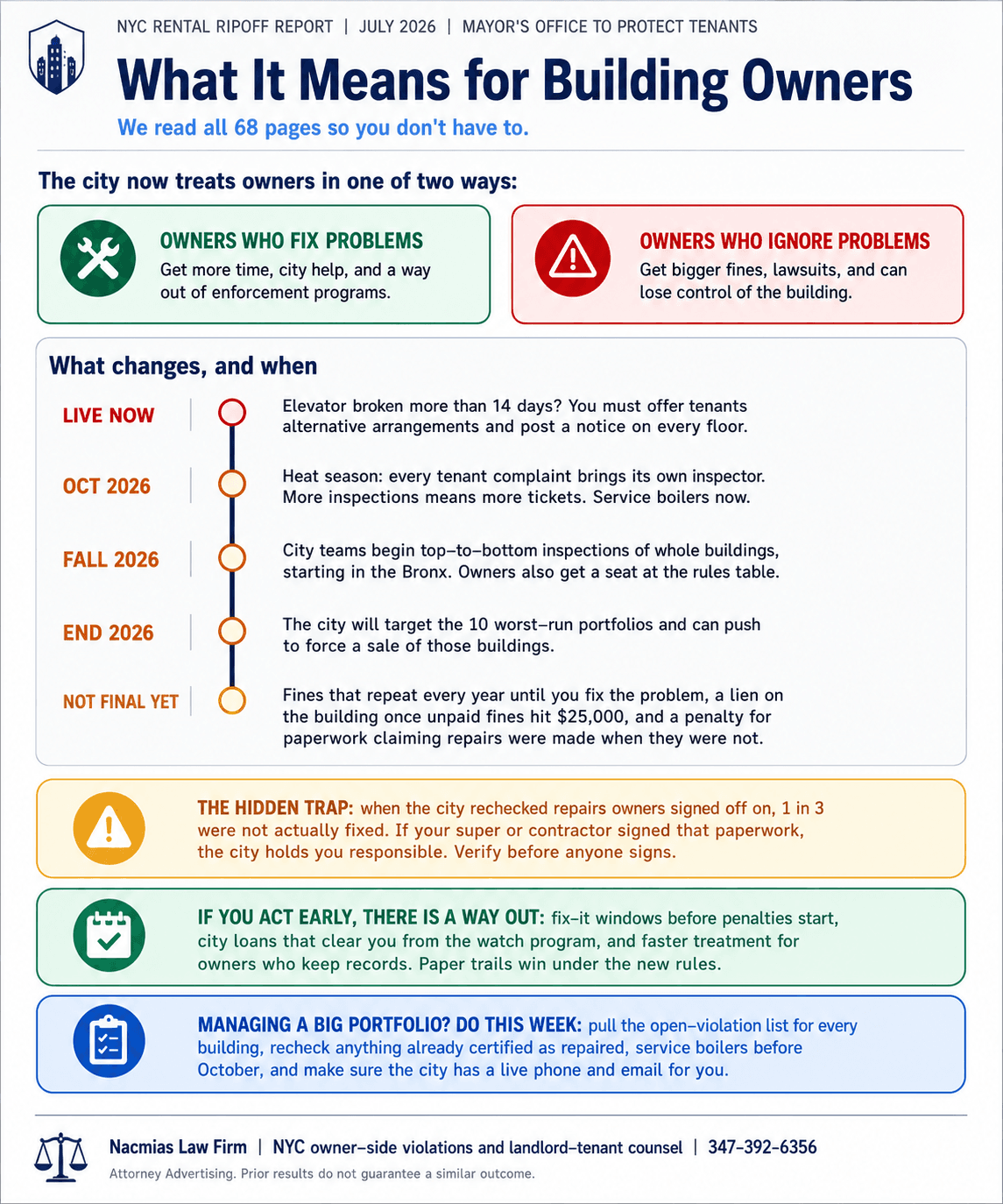
The one-page owner summary
Here is the whole picture on a single page. Save it, print it, or send it to your managing agent so the dates and the exposure sit in one place. Then go to the source: the full 68-page report at nyc.gov.
False self-certification
This is the item most likely to catch a careful owner. The trap is not the slumlord who lies on purpose. It is the ordinary owner whose contractor certifies a repair that was 90 percent done, or closes out a condition that reopened a month later.
The certification gap
32%
of self-certified repairs were falsely certified in FY24-25.
HPD rechecks of the most serious violations in 2025
HPD is auditing Class C corrections far above the required rate.
Source: Rental Ripoff Hearing Report, pp. 45-46.
A false certification can land your building on the Certification Watchlist. That list covers 100 buildings a year and cut false certifications by 10 percent in its first year. An automatic fine for false certification is proposed, not yet law. It would need a Housing Maintenance Code amendment, now moving through the MOPT Legislative Task Force that convenes this Fall.
Under the old audit rate you could get away with a sloppy sign-off by accident. Under a 63 percent reinspection rate for Class C, you cannot. Treat every certification as a legal filing, not a formality, and keep the dated proof behind it.
For what the agencies accept as proof, see my note on certificates of correction.
Bottom line: Audit your own certifications before the City does. One repair signed off at 90 percent is all it takes to land on the watchlist.

The escalation stack
Most of the report’s teeth are still proposed. I mark each item so you know what is law and what is a plan, because owners waste real money reacting to proposals as if they were already in force. Every item below is proposed or under consideration unless noted.
Recurring DOB penalties
ProposedDOB penalties for uncorrected immediately hazardous violations would become annual and recurring rather than one-time.
Expanded DOB liens
ProposedDOB would gain lien authority across all violation categories once penalties total $25,000 or more.
AEP escalation
ProposedThe Alternative Enforcement Program would add increased penalties, multi-year annual fees, a new "Repeat Building Assessment fee," and monitoring fees of up to $1,000 per apartment.
Rent-Impairing Violation expansion
ProposedThe 75-item list, frozen since 1992, would be expanded by rulemaking. Roughly 160,000 rent-impairing violations are already open citywide, and an uncorrected one supports a tenant rent-withholding defense. HPD says it will hold hearings where owners can weigh in.
Debt collection and expedited court
ProposedA Law Department multiagency push aims to collect millions in unpaid debts to the City, with expedited Housing Court processes including 7A receivership under exploration.
Registration modernization
ProposedFaster, cleaner service of process means faster penalty accrual against owners who do not respond.
There is also a leasing and organizing layer. DCWP is running several lanes: FARE Act enforcement (79 or more summonses so far), forthcoming SHIELD debt-collection rules, a coming AI-altered listing disclosure rule, and a proposed credit-check reform letting you require a credit check or 40-times-income proof, but not both.
Separately, a Right to Organize letter signed by Mayor Mamdani and MOPT Executive Director Cea Weaver cites Real Property Law Section 230. It warns that owners who interfere with tenant organizing “may be subject to civil action for damages, attorney’s fees and other costs.” To know what is coming, read the same report from the tenant’s chair in the tenant’s guide.
The common thread is that delay compounds. A one-time penalty becomes a recurring one; an uncorrected condition becomes a lien or a rent-withholding defense. If you are already staring at an OATH or ECB summons, handle that front first through my OATH and ECB violations intake. The OATH hearings roadmap lays out what to expect from summons to decision. If the pressure is a tenant matter instead, a nonpayment, a holdover, or a rent-withholding claim, that is what our landlord-tenant practice handles, and you can bring it to us through the landlord-tenant intake.
Bottom line: Do not spend money fighting proposals that are not law yet. Do move on the conditions behind them, because a corrected condition moots most of this stack.
The penalty schedule owners feel first
Housing Maintenance Code civil penalties by violation class. The daily accrual is what turns a small condition into a large number.
| Class | Condition | Flat penalty | Per-day accrual |
|---|---|---|---|
| A | Non-hazardous | $50 to $150 | $25/day |
| B | Hazardous | $75 to $500 | $25 to $125/day |
| C | Heat / hot water | None | $350 to $1,250/day; $500 to $1,500/day repeat |
| C | Lead paint | None | $250/day, up to $10,000 |
Source: Rental Ripoff Hearing Report, p. 60. Unpaid emergency repair charges the City performs can become a tax lien against the property.
Bottom line: A heat violation left open for a month is not a flat fine, it is a daily meter. Correct fast to stop the count.
The off-ramps for owners who act
This is the part that gets lost when the report is covered only from the tenant side. Nearly every escalation has a paired exit for owners who correct conditions on a schedule. The report describes these, and they matter.
AEP cure and discharge
The Alternative Enforcement Program gives a four-month cure window. An owner who takes an HPD preservation loan with a regulatory agreement is automatically discharged from AEP. Owner-occupied affordable co-ops are excluded from AEP targeting.
Eviction Diversion Working Group
The report frames this as benefiting both tenants and owners, aimed at arrears caused by voucher processing and administrative delay rather than genuine nonpayment.
Clarified response times
Registration modernization is pitched as clarifying response times for the high-road landlords who want to do the right thing, the report’s own words for treating responsive owners differently.
Notice the common condition. Every off-ramp is gated on documented, early correction. None reward an owner who waits to see whether a proposal becomes law. That is why the timing of your response matters more than the merits of any single summons.
Bottom line: The exits exist now. They reward the owner who acts before the deadline, not the one who waits for the law to change.
What it gets right, what needs a reality check
What it gets right
- Self-certification abuse is real, and it hurts honest owners most: the 32 percent false-certification rate is what forces the higher reinspection burden on everyone.
- Ending duplicate batching of heat complaints is a genuine improvement. Batching obscured real conditions and let some buildings hide.
- This is the first City document in years that treats compliant owners as part of the solution rather than a category to be managed.
What needs a reality check
- The inspection-volume math has to meet HPD staffing and the existing OATH backlog. A mandate to attempt every complaint is only as good as the capacity behind it.
- The 21-day pest-correction window sits against a real remediation timeline the report itself puts at “at least three months.” That realignment is under review, and it needs to be.
- Expanding a Rent-Impairing Violations list frozen since 1992 is overdue, but it needs the same calibration so ordinary conditions do not become withholding triggers overnight.
- A flat $25,000 lien threshold treats a contested penalty the same as an ignored one, and any tenant collective-bargaining framework needs defined good-faith obligations.
Those are calibration and due-process questions, not accusations about anyone’s motives. The direction of the report is defensible. The open questions are about volume, timing, and fairness in the details, which is exactly where owners live.
This is not new, and it is not gone
Share of renter households reporting three or more housing problems. The rate has moved in a band for decades, which is part of why the City is treating the fix as structural.
Source: Rental Ripoff Hearing Report, p. 10, NYC Housing and Vacancy Survey.
Do this week
- 1Pull open violations across HPD, DOB, and FDNY for every building in the portfolio.
- 2Audit each self-certification on file and confirm the condition was fully corrected.
- 3Service boilers and confirm hot water before the October 1 heat season starts.
- 4Verify HPD registration and the service-of-process contact are current on every property.
- 5Flag any building near an AEP or Certification Watchlist threshold and start a cure now.
What owners should do before October
- 1
Pull your open-violations picture
Check HPD Online, DOB NOW, and FDNY for every open violation on the building. You cannot correct what you have not seen, and the City is about to look harder than it has in years.
- 2
Audit every self-certification on file
Go back through the certifications your team and contractors have filed and confirm each condition was actually and fully corrected. A repair certified as complete but left at 90 percent is the exact fact pattern the Certification Watchlist is built to catch.
- 3
Get heat-season ready before October 1
Service the boiler, confirm hot water, and fix known heat complaints before the season starts. From the October 2026 heat season, HPD must attempt an inspection for every non-anonymous complaint, and Class C heat penalties run daily.
- 4
Fix your registration and contact information
Confirm your HPD registration and service-of-process contact are current. Registration modernization is designed to make service faster, which means missed notices turn into accruing penalties faster.
- 5
Use the cure windows while they exist
The AEP four-month cure, preservation-loan discharge, and other correction paths reward early action. The report describes them as available now to owners who act, so treat the window as open and use it.
Questions owners ask first
What is the NYC Rental Ripoff Report?
It is a 68-page report the Mayor's Office to Protect Tenants published in July 2026 after the first Rental Ripoff Hearings, which drew 2,419 participants across all five boroughs from February to April 2026. It sets out 23 enforcement recommendations across four strategies. It is not a summary of complaints. It is a plan with dates, proposed legislation, rulemaking, executive action, and litigation.
Does the report affect owners who keep their buildings in good shape?
Yes, but mostly in your favor. The report draws a line between what it calls High-Road and Low-Road landlords and says the City will support the owners who correct conditions while intensifying enforcement against those who do not. The practical catch is documentation: the benefits described in the report flow to owners who can show early, verifiable correction, not just owners who believe they run a clean building.
What hits building owners first?
The elevator rule is already live: since June 2026, an outage over 14 days requires alternative accommodations and posted tenant-rights notices on each affected floor. Next is the October 2026 heat season, when HPD must attempt an inspection for every non-anonymous heat or hot water complaint. After that come Bronx Enforcement Days and the year-end Fix the City portfolio investigations. Everything else in the report is proposed and moving through task forces.
What is a High-Road landlord under the report?
The report's own words: High-Road landlords play by the rules, manage their buildings properly, and keep tenants in safe, stable homes over the long term. Low-Road landlords, by contrast, treat housing as a speculative bet using evictions, disinvestment, or delay to profit. The report is explicit that registration and enforcement changes are meant to hold the second group accountable while clarifying response times for the first.
My contractor certified a repair that was not finished. What is my exposure?
This is the sleeper risk in the report. HPD found that 32 percent of violations were falsely certified in fiscal year 2024-25, and it now reinspects far more Class C violations than the law requires. A false certification can land your building on the Certification Watchlist. An automatic fine for false certification is proposed, not yet law, and would require a Housing Maintenance Code amendment. Audit every certification on file before the City audits it for you.
Can tenants withhold rent because of open violations?
For certain violations, yes. New York's Rent-Impairing Violations list supports a tenant rent-withholding defense when the violation stays uncorrected. That list has 75 items and has not been updated since 1992, and the report notes roughly 160,000 open rent-impairing violations citywide. The report proposes expanding the list through rulemaking, with hearings where owners can weigh in. An open, uncorrected condition is the trigger, so correction is the answer.
What should I do before October 1?
Pull your open-violations picture across HPD, DOB, and FDNY. Audit every self-certification on file so nothing was closed out on a 90-percent-done repair. Get your building heat-season ready before the season starts on October 1. Confirm your registration and contact information are current so notices reach you. And use the correction and cure windows now, while the report describes them as available to owners who act early.
About the author
Michael Nacmias, Esq. is a NYC attorney with over 20 years of legal experience. Since founding Nacmias Law Firm in 2014, he has built the practice around NYC property owners: OATH and HPD violation defense, landlord-tenant litigation, and compliance across all five boroughs.
The report is the city’s plan. What is yours?
We represent NYC property owners across all five boroughs who are prepared to correct conditions and want the record to show it. Tell us what you are facing and we will map the deadlines, the exposure, and the correction path. Our intake starts with one question: is the owner prepared to correct the condition?
Free 15-minute case review. Same-day response. You work directly with the attorney on your case.
Related
What tenants are being told
We wrote the same breakdown for tenants. If you own buildings, it is a preview of the rights your tenants are about to have, and how they will use them.
Landlord-Tenant Law
Holdovers, lease enforcement, and Housing Court for NYC owners.
OATH Violation Defense
Answering DOB, HPD, and FDNY summonses before the deadline.
Legal Disclaimer: This article is general information, not legal advice, and does not create an attorney-client relationship. Every situation is different, so consult an attorney about your specific facts. Attorney Advertising. Prior results do not guarantee a similar outcome.