
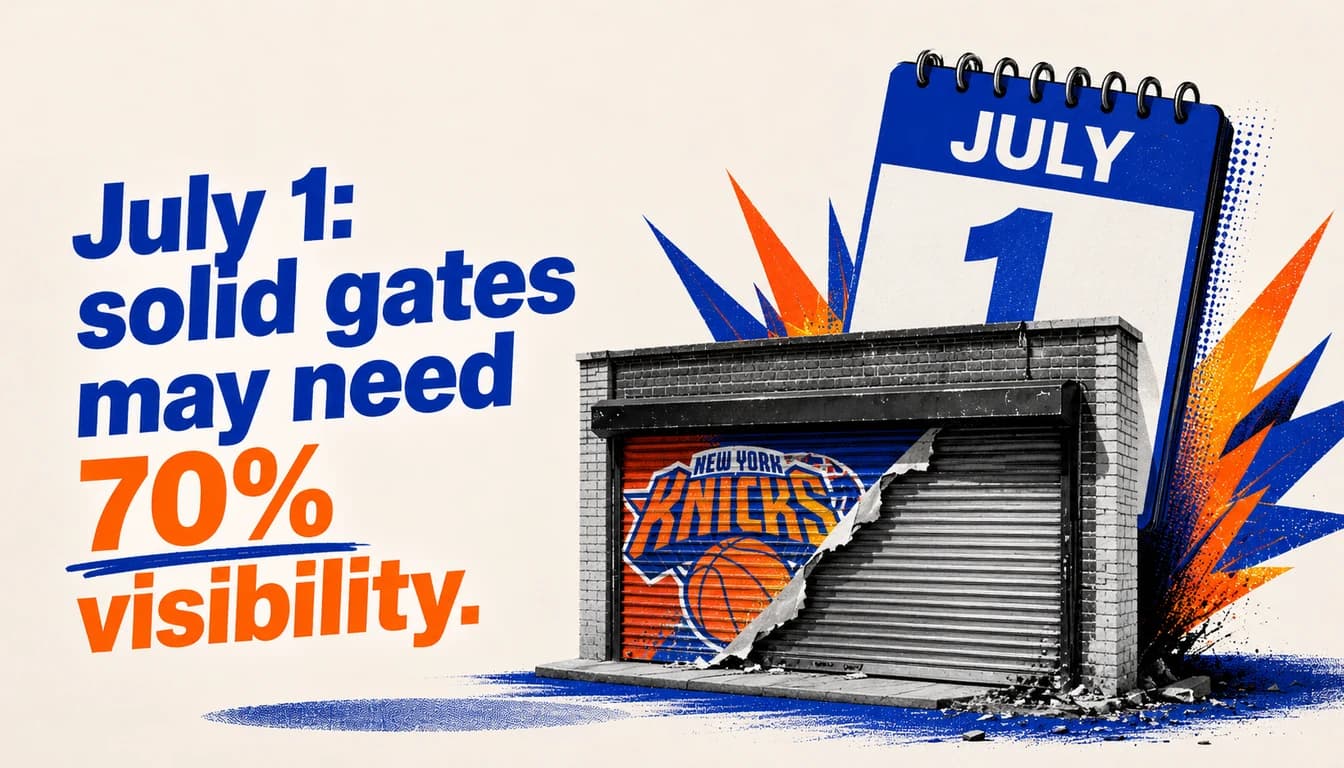
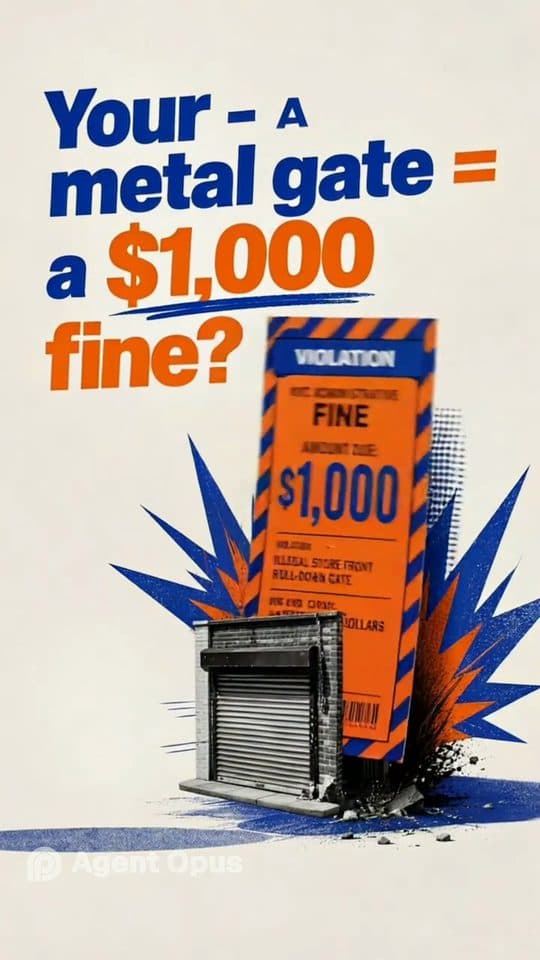

What is the storefront gate law — and is your roll-down gate illegal on July 1?
Starting July 1, 2026, a solid metal roll-down gate on a NYC storefront can draw a Department of Buildings summons returnable to OATH — but for most owners the summons is not the fine. The law that created the deadline also created two defenses: a 90-day correction window that eliminates the penalty entirely, and an affirmative defense, written into the Administrative Code itself, for gates installed before July 1, 2011. Whether you owe anything turns on which side of those two lines you fall — and on raising them correctly.
The deadline comes from Local Law 75 of 2009, a 17-year-old law most owners heard about for the first time this spring. New Yorkers have started calling it "Gate-Gate."
The law, in its own words
Local Law 75 amended the Building Code — today the operative section is BC § 1010.1.4.4 — and set up a two-stage phase-out of solid gates on commercial storefronts. The Council's stated goals in 2009: deter graffiti and let police and firefighters see inside a store when responding to a call. Here is the actual operative text:
"[O]n or after July 1, 2011, no security grille may be installed or replaced … unless the grille, when closed, permits visibility from the sidewalk of at least seventy percent of the area covered by such grille."
— BC § 1010.1.4.4, item 3 (added by Local Law 75 of 2009)
"No later than July 1, 2026, all security grilles installed on buildings or structures classified in occupancy groups B or M shall comply with the provisions of paragraph 3 of this section."
— BC § 1010.1.4.4, item 4
In plain English: since mid-2011, every new or replacement gate had to be the open-grid, see-through kind. And item 4 is the cliff that arrives July 1 — on paper, every gate on a covered storefront must meet the 70% standard by that date.
What's the problem?
Three things collided this spring:
- Nobody told the storefronts. The law sat dormant for 17 years. DOB issued a reminder service notice on February 17, 2026, and most owners learned about the mandate from news coverage after that. Council Member Althea Stevens — now sponsoring the repeal bill — said even she had never heard of it.
- Compliance is expensive. Replacing a gate runs roughly $6,000 to $7,000 according to reporting by Gothamist, and the replacement is not a handyman job: it requires a Registered Design Professional and a DOB permit, and permit processing alone can take well over a month.
- The penalties compound. DOB classifies a non-compliant gate as a major violation, with a summons returnable to the Office of Administrative Trials and Hearings (OATH). The statute sets the fine at not less than $250 for a first offense and not less than $1,000 for each subsequent offense — and "subsequent offense" is how a $250 problem becomes a four-figure one for an owner who ignores it.
So the headlines write themselves: thousands of storefronts, three weeks, $7,000 a gate. But the same law that built the cliff also built the way down from it — and this is the part most of the coverage skips.
The solution: two defenses written into the law itself
When the Council passed Local Law 75, it put the enforcement teeth in Administrative Code § 28-201.2.2, item 5 — and then immediately blunted them. Here is the penalty provision, in its own words:
"[N]o penalty for such violation shall be imposed if the respondent corrects the condition constituting the violation and files a certificate with the department that the condition has been corrected within ninety days from the date set forth in the notice of violation. It shall be an affirmative defense that the nonconforming security grille was installed prior to July 1, 2011."
— Admin. Code § 28-201.2.2, item 5
Two distinct defenses live in those two sentences. Both are still in the current Administrative Code today. Both have traps for the unrepresented.
Defense 1: The 90-day cure that erases the penalty
If a gate summons arrives, you have 90 days from the summons date to correct the condition and file an acceptable Certificate of Correction in DOB NOW: Safety. Do it right and the statute says no penalty shall be imposed — DOB's own service notice confirms you can avoid the hearing and the penalty entirely.
The traps are practical, not legal. The clock runs from the summons date, not the hearing date. The correction itself requires a permit, which requires a Registered Design Professional, which means a 90-day window can evaporate in lead time if you start late. And a Certificate of Correction is only worth something if DOB accepts it — sloppy proof gets rejected, and a rejected certificate after day 90 is just a missed deadline. We wrote a full guide on getting this right: Certificates of Correction in DOB NOW: what counts as acceptable proof.
Defense 2: The pre-2011 affirmative defense — where it came from, and whether it will hold
This is the defense almost no coverage mentions, and for owners of older gates it may be the whole ballgame.
Where it comes from. It is not an agency policy or a lawyer's theory — it is the second sentence of the penalty provision the Council enacted in 2009, and it remains in the Administrative Code today. Read together with the rest of Local Law 75, it functions as a penalty-side grandfather clause: the Council wrote an ambitious retrofit deadline into the Building Code (item 4), but withheld the penalty against any gate that was already in place before the see-through rule took effect on July 1, 2011. The structure tells you this was the legislative compromise — phase out solid gates going forward, but don't fine the owner whose gate predates the rule.
The tension you should understand. Item 4 says all gates must comply by July 1, 2026 — including pre-2011 gates. The affirmative defense says a pre-2011 gate owner cannot be penalized. Both are the law. The practical result: a pre-2011 solid gate is non-compliant but penalty-proof. The City can issue the summons; what it may not do, if the defense is proven, is collect.
Will it actually be honored? The signs point to yes — with caveats:
- DOB's own enforcement position matches the defense. The February 2026 service notice describes violations as applying to non-compliant gates "installed after July 1, 2011." The agency is publicly framing enforcement around the defense line, not the item-4 cliff.
- Small-business guidance reads it the same way. Build Up Justice NYC's guide tells owners flatly that a pre-2011 gate is not legally required to be replaced — but warns that you must be able to prove the installation date.
- It is untested. Enforcement begins July 1, 2026, so no OATH hearing officer has yet ruled on how the defense interacts with item 4. An affirmative defense also does not stop the summons from being issued — it must be raised and proven by you, at the hearing. Default and you lose it.
- The burden of proof is yours. "Affirmative defense" means the respondent proves it. Installation invoices, permit records, dated photographs, lease files, even Google Street View history can establish that the gate predates July 1, 2011. The owners who win this defense will be the ones who walk into OATH with a documented date, not a recollection.
One honest caveat: the defense protects you from the penalty; it does not make a pre-2011 solid gate compliant, and the City could still press for correction. But penalty exposure is what turns a policy dispute into compounding fines — and the statute hands long-standing gate owners a strong card, if it is played at the hearing rather than discovered after a default.
Who is exempt from the law entirely?
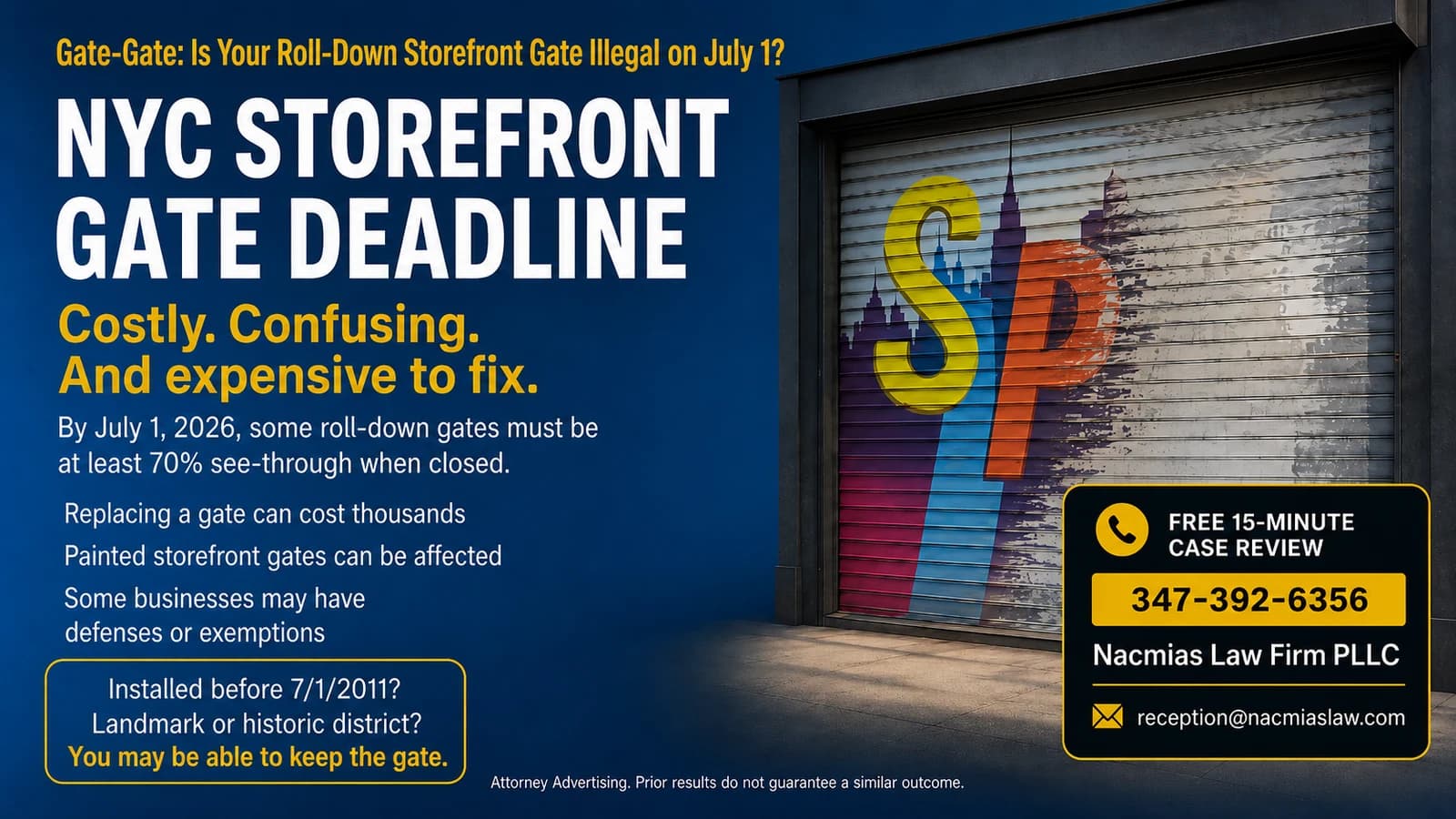
Before reaching either defense, check whether the law applies to you at all. The 70% rule covers security gates that abut the sidewalk on buildings in Occupancy Group B (Business) — offices, banks, professional services — and Occupancy Group M (Mercantile) — retail stores, markets, showrooms. The law itself then exempts:
- Landmarked buildings designated by the Landmarks Preservation Commission;
- Buildings in an LPC-designated historic district;
- Occupancy Group S (Storage) buildings.
If your building is landmarked or sits in a historic district, the requirement does not apply to you at all — confirm your status on LPC's map before spending a dollar on a new gate. The City's guidance at NYC 311 repeats these exemptions.
The street-art problem nobody is talking about
There is a side effect of this law that deserves more attention than it is getting: it reaches the painted gates.
Commissioned murals on roll-down gates are a New York art form. Businesses and institutions pay real money to turn a solid steel curtain into branding, neighborhood identity, or genuine public art — from hand-painted bodega gates to professionally commissioned spray-paint murals on Midtown storefronts. On commercial strips across the five boroughs, the closed gate at night is the storefront's face.
Here is the irony: the Council passed Local Law 75 in 2009 partly to deter graffiti. In the 17 years since, solid gates became the canvas for the opposite — commissioned artwork that owners actually want. An open-grid grille that is 70% see-through leaves very little surface to paint, so complying with the law generally means losing the mural.
And the law contains no exception for artwork. The only exemptions are landmarked buildings, historic districts, and Group S storage — a gate does not get to stay solid because it is beautiful.
If your gate carries a commissioned mural, the analysis is the same as above, with higher stakes: a pre-2011 painted gate may be penalty-proof under the affirmative defense (document the installation date and photograph the artwork now); a post-2011 one puts you to a choice between the art and the summons unless the Council's rescue bill passes — which would let existing painted gates stay until the gate itself is replaced.
Will the City Council kill the deadline first?
Maybe — but it has not happened yet, and you should not bet your summons on it.
On May 14, 2026, Council Member Althea Stevens introduced Int. 910-2026, now carrying more than 30 co-sponsors. The bill would repeal item 4 — the July 1, 2026 retrofit deadline — outright, grandfathering every existing gate and applying the 70% rule only when a gate is newly installed or replaced. It would also order DOB to run a real outreach campaign through the end of 2026. Gothamist reports the mayoral administration supports the change and that DOB has signaled it will hold back enforcement while the legislation moves.
But as of this writing, the bill was heard in the Small Business Committee on June 8, 2026 and laid over — it is not law. Until the Council passes it and the Mayor signs it, July 1 remains the legal deadline, and an enforcement "pause" is an agency posture, not a right you can enforce at a hearing. Plan around the law as written; treat the rescue bill as upside.
What should you do before July 1?
- 1Confirm whether you're covered. Group B or M storefront with a sidewalk-facing gate? Then check the exemptions: landmark or historic-district status takes you out entirely.
- 2Date your gate. If it was installed before July 1, 2011, gather the proof now — invoices, permits, dated photos. That documentation is the affirmative defense.
- 3If your gate went in after July 1, 2011 and is solid, get a quote from a gate installer and line up the Registered Design Professional you'd need for the DOB permit — even if you wait to see what the Council does, you want the 90-day cure to be executable, not theoretical.
- 4If a summons arrives, calendar the OATH hearing date immediately and start the Certificate of Correction clock. The 90-day cure runs from the summons date, not the hearing date.
- 5Get the summons reviewed. Wrong occupancy group, exempt building, pre-2011 installation, defective service — gate summonses will be issued in volume this summer, and volume enforcement makes mistakes.
If a gate summons lands on your storefront anywhere in the five boroughs, send it to us the day it arrives — a free case review takes 15 minutes, and both defenses are strongest when they are raised early. You can reach our office at 592 Pacific Street, Brooklyn, or through the contact form on this site.
Sources
- Local Law 75 of 2009 (full text, PDF)
- NYC Administrative Code § 28-201.2.2 (current text — specified major violations)
- DOB Service Notice, Feb. 17, 2026 — Requirement Deadline for Roll-down Security Grilles (PDF)
- NYC 311 — Open Grid Security Gates (KA-03709)
- NYC Council, Int. 910-2026 (Legistar)
- Build Up Justice NYC — What Small Businesses Need to Know About NYC's Storefront Gate Law
- Gothamist — "NYC Council scrambles to reverse impending ban on metal storefront security gates" (June 8, 2026)
This article is attorney advertising and is provided for general information only; it is not legal advice for your specific situation. Prior results do not guarantee a similar outcome.

